Grey belt reforms fuel surge in planning applications as approvals sink to record lows


A planning system pulling in two directions
England's housing market is delivering a genuinely strange signal right now. Applications for new homes are climbing sharply, driven in large part by Labour's grey belt reforms and the passage of the Planning and Infrastructure Act 2025. Yet the number of homes actually being granted permission has fallen to some of the lowest levels since comparable records began in 1979.
Planning Portal data shows applications for 335,000 homes were lodged outside London in 2025, a 60% increase on 2024, with the final quarter alone up 61% year-on-year. At the same time, official figures show fewer than 29,000 residential projects were granted permission in the year to June 2025, and just 7,000 applications were approved between April and June — the lowest quarterly figure since 1979. Across the whole of 2025, roughly 180,000 to 202,800 homes were approved for development, by some measures the lowest annual total in over two decades.
For developers, lenders and investors underwriting UK residential exposure, this divergence matters more than either headline in isolation. Planning approvals are the leading indicator for supply three to five years out. A rising queue of applications sitting behind a shrinking approval funnel points to lengthening determination times, growing local authority backlogs, and a widening gap between political ambition and deliverable pipeline — precisely the conditions that make the 1.5 million homes target, equivalent to roughly 300,000 net additions a year, look increasingly stretched.
What grey belt has actually changed
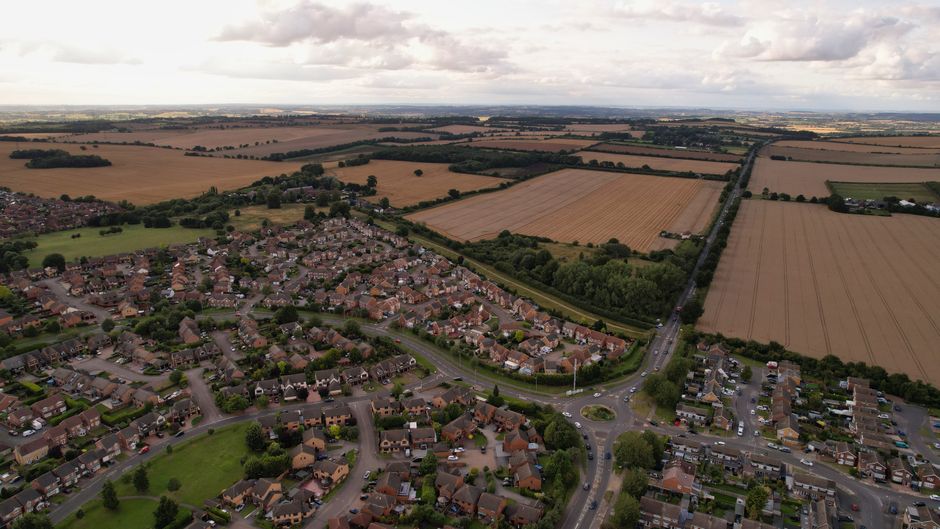
The grey belt designation, introduced in the December 2024 National Planning Policy Framework and cemented in statute by the Planning and Infrastructure Act 2025, targets land within the Green Belt judged to make a "limited contribution" to the purposes Green Belt policy is meant to serve — disused car parks, degraded scrub, low-grade agricultural fringe. In principle this unlocks a targeted slice of England's roughly 1.6 million hectares of Green Belt without touching genuinely protected countryside.
In practice, the definition has proved far more elastic than ministers initially suggested. Research from the London Green Belt Council and CPRE Hertfordshire found 89% of Green Belt applications in Hertfordshire over the past year were classified by developers as grey belt, while over 80% of London Green Belt appeals decided in 2024 were approved on grey belt grounds — more than double the historic approval rate for Green Belt applications generally. By March 2025, over 100 appeal decisions nationally had cited the grey belt concept, an unusually fast uptake for a policy barely three months old at that point.
REalyse planning data shows this playing out geographically in the areas under the most acute housing pressure. Central London, Greater Manchester, the West Midlands, Kent and Essex lead in application volumes, while commuter-belt authorities such as Buckinghamshire, Central Bedfordshire and West Northamptonshire each show tens of thousands of proposed units in the current cycle — precisely the districts where Green Belt boundaries sit closest to housing demand. Early consents already granted include schemes of 550 homes in St Albans, 250 near Basildon and 135 in Bagshot, Surrey — sites that would very likely have been refused under the pre-2024 framework.
Why approvals are falling even as applications rise
The counterintuitive part of this story is that approval rates for decided applications have held up reasonably well — running in the high-70s to low-80s by unit volume, only a few percentage points below 2020 highs. What has collapsed is the volume of large schemes reaching determination in the first place. REalyse data shows granted residential units in England peaked at just under 459,000 across nearly 22,000 approvals in 2021, falling to around 202,000 granted units across roughly 10,400 approvals by 2025 — a decline of more than 55% in granted unit volume in four years.
This points to a pipeline problem rather than a committee-caution problem. Refusals have fallen too, from around 6,900 in 2020 to roughly 4,200 in 2025, suggesting fewer ambitious schemes are being brought forward for decision at all — a signal that developer confidence, land assembly and scheme viability are constraining supply as much as, or more than, planning committees themselves. Under-resourced planning departments, determination times stretching past 12 months for major applications, and a Building Safety Regulator process for high-rise schemes that has so far rejected 69% of pre-construction applications are all compounding the lag between application and decision.
What this means for developers, lenders and investors
For institutional players, the near-term opportunity lies less in waiting for the 1.5 million target to be hit and more in using granular local authority, grey belt and scheme-status data to separate genuinely deliverable pipeline from applications that will sit dormant. REalyse comparables data for grey belt-adjacent commuter locations already shows achieved new-build sale prices of £450–£600 per square foot or more in higher-pressure South East markets, underlining the value uplift once planning certainty is secured on previously unbuildable land.
Lenders assessing collateral and viability should treat rising application volumes with caution rather than as a proxy for near-term completions: outline permissions, which make up a large share of the current surge, convert to full applications and completed homes at a materially lower rate than direct full applications. Agents and valuers working grey belt-adjacent areas will increasingly need site-specific evidence — approval rates, appeal outcomes and comparable land values — to support pricing conversations with vendors and landowners who may be anchoring on national headlines about surging demand rather than local delivery realities.
Outlook
The direction of policy travel is coherent: mandatory local housing targets, streamlined consenting and grey belt release all address genuine structural blockages in the English planning system. But the data confirms that approval volumes, not political intent, remain the binding constraint on the 1.5 million homes pledge, and the lag between consent and completion means today's depressed approval figures will constrain supply well into the back half of this Parliament. Expect continued selectivity from institutional capital — favouring authorities and site types where planning risk is lower and delivery timelines are better evidenced — while the sector waits to see whether 2025's application surge eventually shows up in the metric that actually matters: completions.