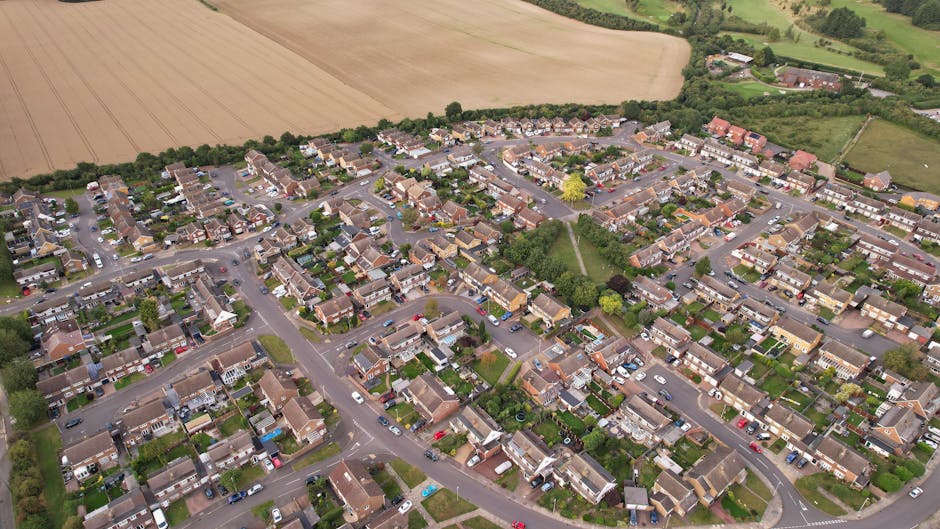
Suburban single-family rental communities emerge as the new frontier for UK build-to-rent capital


The UK's build-to-rent sector is undergoing a quiet revolution. While city-centre apartment blocks have dominated BTR headlines since the sector's emergence a decade ago, institutional capital is increasingly flowing toward a different proposition entirely: suburban single-family rental communities designed for families who want the space of homeownership without the commitment.
This pivot reflects a structural change in how and where British households want to live—and where investors see the most compelling risk-adjusted returns.
The remote work dividend: suburban demand finds its funding
The pandemic's most enduring legacy on UK housing may be its validation of distributed work. REalyse analysis of travel-to-work patterns shows that remote working has become deeply embedded across British households, with work-from-home rates averaging over 50% across most postcode areas.
This shift has fundamentally altered the geography of housing demand. Families no longer need to balance school catchments against commute times with the same intensity. The result is sustained pressure on suburban housing stock—particularly detached and semi-detached family homes in locations with good schools and green space.
Traditional housebuilders have been slow to respond to this demand surge, constrained by planning delays, elevated construction costs, and the ongoing mortgage affordability squeeze. Enter the single-family build-to-rent (SFBTR) operator, offering professionally managed homes at a scale that individual landlords cannot match.
The SFBTR pipeline: institutional capital finds new ground
REalyse planning data reveals a substantial SFBTR pipeline taking shape across England and Scotland. Greater Manchester leads with over 5,100 units across 32 planning applications, reflecting the region's combination of employment base, housing affordability constraints, and planning authority receptivity. Cambridgeshire follows with over 9,000 units in the pipeline, concentrated in masterplanned communities around Cambridge's expanding life sciences and technology employment clusters.
The Midlands and North of England dominate SFBTR activity, with significant concentrations in:
• Nottinghamshire: Approximately 2,600 units across 10 applications
• South Yorkshire: Nearly 2,900 units with an average scheme size of 242 homes
• West Midlands: Over 2,100 units spanning 12 developments
• Merseyside: More than 2,100 units in 9 schemes
Average scheme sizes range from 130 to 250 homes, suggesting developers are targeting the operational efficiencies that come with neighbourhood-scale communities rather than scattered individual properties. This scale enables on-site management, shared amenities, and the energy-efficient specifications that both regulations and tenant demand now require.
Yield compression in cities drives suburban appetite
The investment thesis for suburban SFBTR is compelling when viewed through a yield lens. REalyse rental market data shows gross yields in regional markets substantially outperforming London. Areas like Sunderland (SR) are delivering yields approaching 9-10%, while Liverpool (L), Newcastle (NE), and Sheffield (S) consistently achieve 6-7%—compared to sub-4% yields typical of prime London postcodes.
This yield premium reflects both lower land values and robust rental demand from households priced out of homeownership. With family household concentrations exceeding 70% in many outer London and Midlands districts—areas like Hounslow (TW5, TW4), east London (IG, E6, E7), and the West Midlands (B8, B10)—the target demographic for SFBTR is abundant and underserved.
Energy efficiency requirements add another dimension. New-build SFBTR communities are being delivered to EPC A and B standards, insulating operators from the regulatory pressure mounting on older private rented stock. Tenants increasingly factor energy costs into their housing decisions, making efficient homes more lettable and reducing void periods.
What this means for the market
The rise of suburban SFBTR represents more than a tactical reallocation by a few operators. It signals institutional capital's growing sophistication about UK housing demand—and its recognition that the pandemic accelerated a pre-existing suburban drift rather than creating a temporary anomaly.
For developers, the opportunity lies in sites that might previously have been destined for for-sale housing. For investors, SFBTR offers a diversification play within residential portfolios, with lower tenant turnover than urban apartments and longer average tenancies. For local authorities, professionally managed rental communities can deliver housing supply without the affordable housing negotiations that often delay for-sale schemes.
The trajectory is clear: UK institutional residential investment is no longer synonymous with urban towers. The future of build-to-rent increasingly looks like a cul-de-sac.