Labour's planning reforms and green belt housing: where the next building boom could land


A planning system under pressure
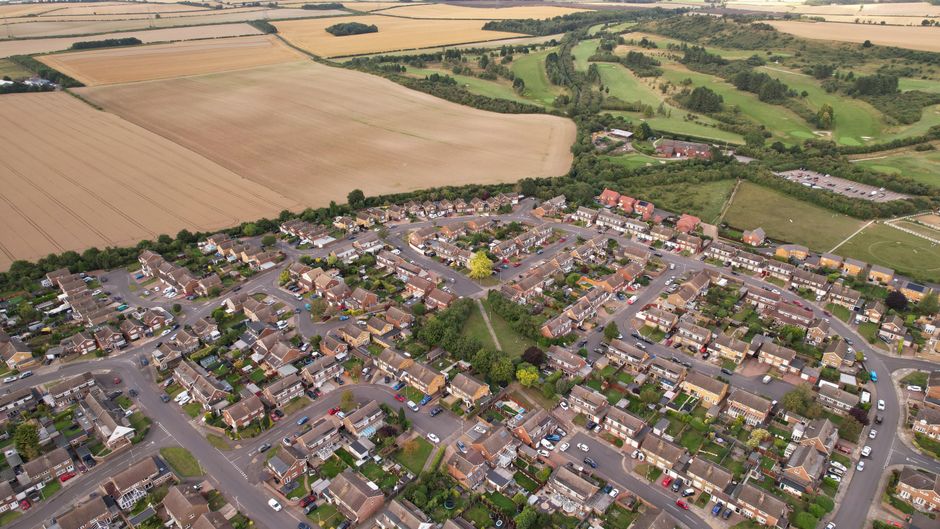
Labour's manifesto commitment to build 1.5 million homes over this Parliament has put the planning system back at the centre of the housing debate. Mandatory local housing targets are returning, local authorities are being pushed to review green belt boundaries, and a new "grey belt" category has been introduced to capture poor-quality or previously developed green belt land that could be released for development without touching genuinely valued countryside.
This matters most in the commuter belt around London and other major cities, where green belt designation has long acted as a hard boundary against sprawl, but also as a constraint on supply in exactly the areas where demand, and prices, are highest.
How much green belt land is actually in play
REalyse land data shows green belt parcels account for roughly 3% of all mapped land parcels nationally, but around 10% of total mapped land area, reflecting the fact that green belt designations tend to cover large, low-density tracts ringing major urban centres. That is a meaningful land bank in absolute terms, even before "grey belt" carve-outs are considered.
What stands out is how little of the current residential planning pipeline touches green belt land directly under current rules. REalyse's planning application data shows the overwhelming majority of proposed residential units, into the millions nationally, sit on non-green belt sites, with green belt schemes still a rounding error in comparison. That gap is precisely what the reform agenda is aimed at closing: if even a modest share of grey belt land is reclassified and unlocked, it could represent one of the largest single releases of developable land in a generation.
For investors and developers, this creates a watchlist dynamic. Sites currently written off because of green belt status may become viable again once local plans are updated, and early identification of grey belt candidates, low-quality, poorly performing green belt parcels near existing infrastructure, could be a meaningful source of edge.
Where housing delivery is already concentrated
Even without green belt reform, REalyse's planning pipeline data shows housing delivery is already clustering hard around London's commuter belt. Local authorities such as Ashford in Kent, Huntingdonshire in Cambridgeshire, and Tower Hamlets in London currently lead the South East on proposed residential units, with pipelines in the 6,000 to 12,000-unit range over the past three years across schemes granted or in progress.
Notably, average scheme size varies enormously by area. Ashford's pipeline is dominated by a small number of very large sites, averaging over 300 units per application, while places like Buckinghamshire are seeing housing delivered through a much larger number of smaller schemes, averaging around 34 units each. This distinction matters for green belt policy: large strategic urban extensions are the type of scheme most likely to require green belt or grey belt release, while smaller infill schemes are more likely to proceed on non-green belt land regardless of reform.
For lenders and investors underwriting development finance, this points to a two-speed market emerging: established growth corridors like Cambridgeshire and parts of Kent, where the pipeline is already strong, versus green belt-constrained authorities in the London fringe, where reform could unlock a step-change in supply if local plans move quickly enough.
The tension with local opposition
The political risk in this agenda is not the principle of building more homes, it is the pace and location. Green belt boundaries have historically been defended fiercely at the local level, and mandatory housing targets removing local authorities' discretion to say no is likely to generate friction in exactly the affluent, high-demand commuter areas where land value uplift from reclassification would be greatest.
This creates a valuation dynamic worth watching closely. Land values on the fringes of existing settlements can shift materially once a site moves from "protected" to "allocated for development" in a local plan, and REalyse-style comparables across recently granted schemes in similar locations can help investors and lenders form a view on realistic uplift, well before a formal allocation is confirmed. Given the volumes at stake, sites near infrastructure, on lower-grade green belt land, in authorities under the most housing delivery pressure, are the ones most likely to move first.
Outlook
Labour's reform agenda has the ingredients to meaningfully shift housing supply dynamics in the areas that need it most, but the mechanics of grey belt release, local plan timelines, and political appetite for enforcement will determine how quickly that translates into homes on the ground. In the meantime, the data points to where the pressure is already building: commuter belt authorities with strong pipelines today are likely to be the first movers if green belt policy loosens further, while green belt-constrained areas remain the ones to watch for the biggest potential re-rating in land value.