Labour's 1.5 million homes pledge and grey-belt reforms put England's planning system to the test


England's housing ambitions collide with a fractured planning machine
When Keir Starmer's government set its target of 1.5 million new homes in England by 2029, it was making a political bet that sheer ambition, backed by reformed planning rules, could break a decades-long logjam. Achieving that target requires roughly 300,000 net additional dwellings a year — a figure England has not hit since the late 1960s.
The National Planning Policy Framework (NPPF), overhauled by Labour in late 2024, restored mandatory housing targets for local authorities, introduced a stronger "presumption in favour of sustainable development," and — most controversially — created a new category of land known as the "grey belt." Understanding how the planning pipeline is actually performing, and how councils are responding, is essential for anyone working in development, investment or lending.
The delivery gap: what the data really shows
REalyse planning data covering residential applications across England reveals an uncomfortable truth at the heart of the housing debate: the problem is not simply one of applications refused, but of approved schemes that never become homes.
Between 2020 and 2025, residential planning applications in England proposed over 1.9 million housing units in aggregate. Yet across the same period, applications submitted in 2020 — which have had the longest time to progress through construction — saw only around 67,500 units recorded as built on site. By 2022, that figure had dropped to fewer than 18,000 for that cohort, reflecting the structural lag between consent and completion that plagues the English system.
A more striking pattern emerges when looking at scheme size. In 2020, the average residential planning application proposed around 13 units. By 2025, that figure had roughly doubled to approximately 28 units per application — even as the total number of applications submitted fell by nearly 40% from their 2021 peak. Developers are clearly pursuing larger, more commercially viable schemes, a rational response to both rising build costs and a policy environment that now rewards boldness at scale.
Perhaps most telling is the sheer weight of homes in the pending pipeline. REalyse data shows that as of mid-2026, over 675,000 housing units sit in planning applications that remain undecided across England — a backlog that represents both the opportunity and the bottleneck the government must address.
What is "grey belt" — and why does it matter?
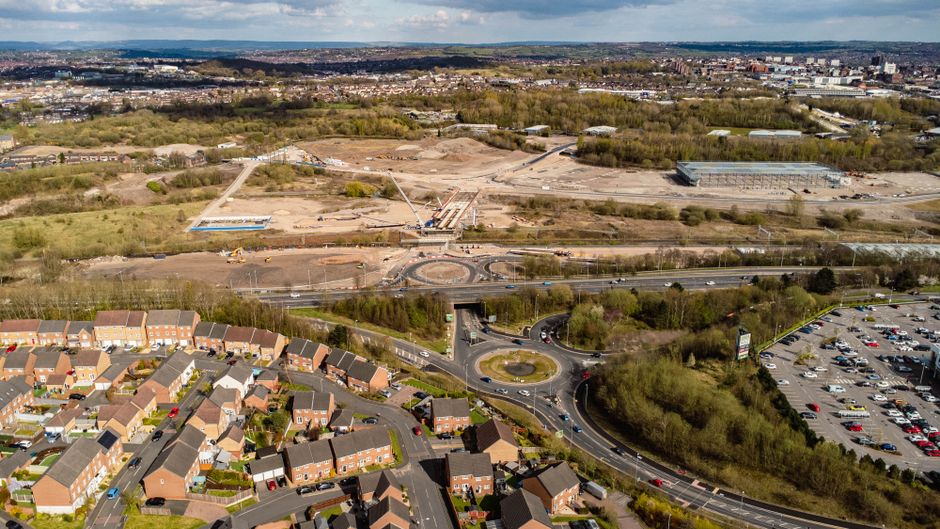
The grey belt concept is Labour's answer to the political impasse over building on the green belt. The reformed NPPF defines grey belt as land within the green belt that has "limited contribution" to the five purposes of green belt policy — think scrappy car parks, degraded industrial sites, or low-quality agricultural land on the urban fringe that has been protected largely by inertia rather than genuine ecological or amenity value.
Councils are now required to review their green belt boundaries when they cannot meet their housing targets through other means — and the reformed policy effectively removes the "very special circumstances" bar for grey belt sites, replacing it with a set of "golden rules" around affordable housing provision (a minimum 50% affordable on grey belt sites), infrastructure contributions, and access to green space.
For developers and investors, this is a material shift. Land that was previously unbuildable — and priced accordingly — could now carry residential consent. REalyse data already shows 2025 producing the highest volume of proposed housing units in the six-year dataset period (over 416,000 units in residential applications submitted that year alone), suggesting that the grey belt signal is already influencing what schemes developers are bringing forward.
The land market implications are significant. Grey belt sites that clear the golden rules test could see values move sharply upward as residential use becomes viable. For lenders and investors underwriting deals near green belt boundaries, the risk profile of "hope value" land has changed meaningfully.
The local authority picture: leaders, laggards, and early movers
Not all councils are responding to the new environment at the same pace. REalyse data on the top 20 English local authorities by total housing units proposed shows a delivery rate — the proportion of proposed units that have progressed to on-site construction — ranging from just 12.7% (Milton Keynes) to 52.6% (Manchester), with an average across the cohort of approximately 33%.
Manchester's performance stands out. With nearly 34,000 units proposed across its planning pipeline and a delivery rate of over 52%, it demonstrates what is possible when a city combines political will, a healthy investor market, and a track record of urban regeneration. Birmingham and Tower Hamlets both exceed 40%, reflecting the scale and density achievable in major urban centres.
At the other end, some councils with significant land allocations are converting proposals into homes at a fraction of that rate. Milton Keynes — long held up as a model of planned growth — sits at just 12.7%, raising questions about the gap between allocated land and the infrastructure and viability conditions needed to unlock it. Ashford in Kent, a designated growth area with over 32,000 units proposed, shows a delivery rate of only 20%.
The new mandatory targets imposed under the revised NPPF will put direct pressure on lagging authorities. Councils that cannot demonstrate a five-year housing land supply now face an automatic presumption in favour of development — effectively handing developers a stronger hand at appeal.
The appeals system: pressure valve or bottleneck?
One of the less-discussed consequences of the housing targets reform is its effect on the planning appeals system. The strengthened presumption in favour of sustainable development means that where a local plan is out of date or targets are not being met, applicants have a clearer route to appeal a refusal and succeed.
Across the entire REalyse England planning dataset, 129,146 applications have been refused, representing over 569,000 housing units that did not receive consent at first instance. A further 55,506 applications — carrying nearly 261,000 units — were withdrawn, often a sign that applicants anticipated refusal or faced pre-determination pressure. Together, that is a pool of nearly 830,000 refused or abandoned units that the appeals system and revised policy could, in theory, help unlock over time.
The Planning Inspectorate, however, is already under significant strain. Industry bodies have warned that a surge in appeals — driven by developers testing grey belt classifications and challenging councils' housing supply calculations — could extend appeal timescales well beyond the current average of 30–36 weeks for written representations. Without additional resourcing, the appeals pipeline risks becoming as congested as the application one.
What this means for developers, investors and lenders
For anyone active in UK residential development or investment, the reform landscape creates both opportunity and complexity in roughly equal measure.
On the opportunity side, the grey belt reclassification represents the most meaningful expansion of the developable land pool since the 1947 Town and Country Planning Act. Land promoted near existing urban centres, with good transport links and limited green belt value, is now in genuine play. REalyse valuation and planning data can help identify which parcels sit in the sweet spot — close enough to urban demand to command viable values, but degraded enough in character to clear the grey belt bar.
The 50% affordable housing golden rule is a real viability challenge, particularly in lower-value markets where the economics of mixed-tenure development are already marginal. Investors and developers will need robust appraisals that stress-test affordable obligations against realistic land values and build cost assumptions. In higher-value areas — outer London, the commuter belt, prosperous regional cities — the maths is more likely to work.
For lenders, the key risk is timing. The policy framework is new, grey belt boundaries are not yet drawn in most local plans, and the courts will inevitably be asked to define the edges of the new category. Schemes being underwritten today against grey belt hope value carry genuine planning risk that must be reflected in loan-to-value ratios and drawdown conditions.
Conclusion: ambition is necessary, but execution is everything
Labour's 1.5 million homes pledge has injected genuine urgency into English housing policy. The grey belt reforms, mandatory targets and strengthened appeals backstop are the most substantive planning reforms in a decade. The early data suggests the development sector is responding — scheme sizes are rising and the pipeline of proposed units is growing.
But the delivery gap documented in REalyse data is a structural challenge that policy alone cannot solve. Planning permissions do not build homes. Infrastructure funding, build cost inflation, the capacity of the construction supply chain, and the viability of affordable housing obligations will all determine whether the ambition translates into completions.
The councils, developers and investors who move earliest — identifying grey belt opportunities, aligning with revised local plans, and building relationships with planning authorities navigating new targets — stand to benefit most from what could be the most significant reshaping of the English planning system in a generation.